zkDeal engineering · Technology Brief
Run the supplied Docker stack—or customize any role
Start with zkDeal’s published Docker operating planes, inspect a digest-pinned CUDA prover, and learn where customization keeps the proof and settlement boundaries intact.
DEPLOYABLE DOCKER ARCHITECTURE • READY-TO-RUN IMAGES
Run the supplied Docker stack—or customize any role
zkdeal supplies separate Docker images for live room execution, operations and validation. Teams can run the default topology, co-locate roles for a smaller deployment, or substitute individual components while preserving the selected room and settlement boundaries.
From an application request to Ethereum settlement
Explore the architecture
Deployable Docker architecture
Drag the canvas to pan, use the wheel or pinch gesture to zoom, and use the controls to zoom or fit the whole model. Expand for a page-sized view; press Escape to close it.
View the static reference image
Read the figure transcript
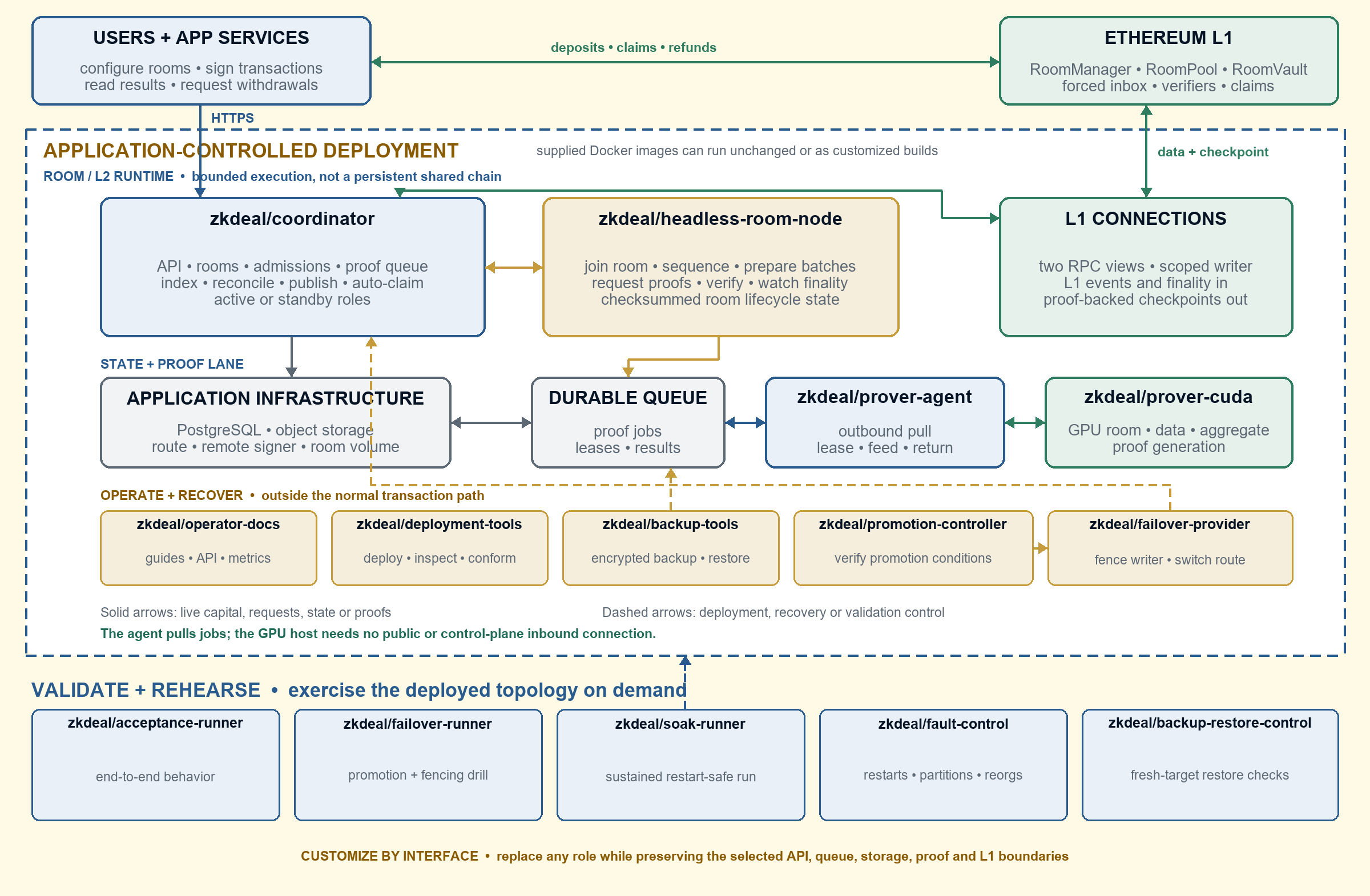
zkdeal deployment architecture. Users and app services send signed room requests to the coordinator and interact directly with Ethereum for deposits, claims and refunds. The coordinator works with a headless room node, durable storage and a pull-only proving lane made of prover-agent and prover-cuda. Ethereum L1 receives data and proof-backed checkpoints. Operator, deployment, backup, promotion and failover images support the live stack. Acceptance, failover, soak, fault-control and backup-restore images validate it on demand. Every role can be customized behind the same interfaces.
Ready images by operating plane
RUN zkdeal/coordinator hosts the API and service roles; zkdeal/headless-room-node runs bounded room execution; zkdeal/prover-agent pulls proof work; zkdeal/prover-cuda generates room, data and aggregate proofs.
OPERATE + RECOVER zkdeal/operator-docs, zkdeal/deployment-tools and zkdeal/backup-tools support the deployment; zkdeal/promotion-controller and zkdeal/failover-provider verify a handoff, fence the old writer and switch the route.
VALIDATE + REHEARSE zkdeal/acceptance-runner, zkdeal/failover-runner, zkdeal/soak-runner, zkdeal/fault-control and zkdeal/backup-restore-control exercise normal operation, recovery, long runs, controlled faults and clean-target restore.
Customize by interface, then revalidate the chosen profile
Motivational example
Start with something you can run this afternoon
Suppose you want to know whether the prover really uses your GPU. The quickest useful answer is not another architecture diagram. Pull one immutable image, let Docker present the device, and ask the running service what it can do.
That small experiment also shows why the stack is split into roles. You can begin with zkDeal’s published prover, coordinator, room node, and recovery path, then replace one role when you have a reason to own it. The boundary is concrete: preserve the API, queue, proof format, storage, and Ethereum behavior required by the room profile, then run the same checks again.
- Pull the B200-native sm100 prover by immutable digest.
- Confirm native cubins, CUDA production mode, and disabled CPU and PTX fallbacks.
- Keep the evaluation listener on loopback and keep identity fields out of copied logs.
Demo / use it today
Inspect a digest-pinned B200 prover
This smoke path checks four concrete things: the exact public image was selected, its executable carries native sm100 cubins, Docker can pass a B200 into it, and the running service reports a production CUDA build with CPU and PTX fallbacks disabled.
Before you start
- A Bash-compatible shell: Linux, macOS, or WSL on Windows. The copyable commands use POSIX shell syntax.
- Docker with the NVIDIA Container Toolkit and an NVIDIA B200 (compute capability 10.0).
- OpenSSL for an unprinted temporary token, plus curl and jq for deliberately filtered readiness output.
- A free loopback port 8080 and no other GPU compute container.
Pin first
The tutorial assigns the full architecture-specific digest to IMAGE. It never uses latest, and the pull output must repeat the same digest.
Verify the hardware boundary
The first disposable run asks NVIDIA for the model and compute capability. The next check inspects the executable for sm100 cubins before the service is allowed to prove with PTX JIT disabled.
Inspect only safe fields
The service routes include richer identity data. The jq projections intentionally omit GPU UUID, guest program identifiers, container telemetry labels, and any token.
Pin the public image
IMAGE=zkdeal/prover-cuda@sha256:e1a0b4b36637a415823fdcf1139657884dfa1f1016441a8d1e3701bed4483d67Pull by digest
docker pull "$IMAGE"Expected output shape
Digest: sha256:e1a0b4b36637a415823fdcf1139657884dfa1f1016441a8d1e3701bed4483d67
Status: Image is up to date for zkdeal/prover-cuda@sha256:e1a0b4b3…
Confirm the GPU architecture
docker run --rm --gpus all --entrypoint nvidia-smi "$IMAGE" \
  --query-gpu=name,compute_cap --format=csv,noheader
Expected output shape
NVIDIA B200, 10.0Bind the image to its public source checkpoint
docker image inspect "$IMAGE" --format '{{json .Config.Labels}}' | jq -c \
  '{source:."org.opencontainers.image.source",revision:."org.opencontainers.image.revision",sourceManifest:."org.opencontainers.image.source-manifest.sha256"}'
Expected output shape
{"source":"https://github.com/zkdeal/zkdeal-prover","revision":"d60547ba7e040d2ba77bd154bb6e20c10d276657","sourceManifest":"7e14703e340e84aaca2af36224b6fb1e47ce0c2f64f2a88d9eb09d932800246f"}Extract the prover binary without starting it
BIN_DIR="$(mktemp -d)" && CID="$(docker create "$IMAGE")" && \
  docker cp "$CID:/usr/local/bin/zkdeal-r0" "$BIN_DIR/zkdeal-r0" && \
  docker rm "$CID" >/dev/null
Require native sm100 cubins
docker run --rm -v "$BIN_DIR/zkdeal-r0:/tmp/zkdeal-r0:ro" \
  nvidia/cuda:12.9.1-devel-ubuntu22.04@sha256:38804006c937a83f28f63a959abcee688042072319c8614ad57b350958a30bd3 \
  cuobjdump -lelf /tmp/zkdeal-r0 | grep '\.sm_100\.cubin'
Expected output shape
ELF file    1: zkdeal-r0.1.sm_100.cubin
ELF file    2: zkdeal-r0.2.sm_100.cubin
ELF file    3: zkdeal-r0.3.sm_100.cubin
ELF file    4: zkdeal-r0.4.sm_100.cubin
ELF file    5: zkdeal-r0.5.sm_100.cubin
Generate a temporary token without printing it
export ZKDEAL_PROVER_TOKEN="$(openssl rand -hex 32)"Start a loopback-only smoke service
PROVER_ID="$(docker run --rm --gpus all -d \
  -p 127.0.0.1:8080:8080 -e ZKDEAL_PROVER_TOKEN -e CUDA_DISABLE_PTX_JIT=1 \
  -e SEGMENT_PO2=20 "$IMAGE")" && export PROVER_ID
Read sanitized readiness
curl -fsS http://127.0.0.1:8080/healthz | \
  jq '{status,protocolVersion,evmFork,cpuFallback,prover}'
Expected output shape
{"status":"ready","protocolVersion":6,"evmFork":"osaka","cpuFallback":false,"prover":"risc0-local-cuda"}Read sanitized capabilities
curl -fsS http://127.0.0.1:8080/v5/capabilities | \
  jq '{protocolVersion,backendId,cudaCompiled,productionCompiled,proofModes,ethereumSeal}'
Expected output shape
{"protocolVersion":6,"backendId":"risc0","cudaCompiled":true,"productionCompiled":true,"proofModes":["succinct","groth16"],"ethereumSeal":true}Remove the disposable service
docker stop "$PROVER_ID" >/dev/null && rm -r -- "$BIN_DIR" && \
unset PROVER_ID ZKDEAL_PROVER_TOKEN BIN_DIR CIDWhat this gives you: A native sm100 cubin list plus protocolVersion 6, cudaCompiled and productionCompiled true, and cpuFallback false is the minimum useful smoke signal. The companion Kurtosis run then completed its cold proof and checkpoint path on the same B200-native image.
Interactive validated I/O
Inspect the digest-pinned B200 prover
Select text directly in the player, pause at any point, or copy the complete transcript below.
Copy or read the complete transcript
$ IMAGE=zkdeal/prover-cuda@sha256:e1a0b4b36637a415823fdcf1139657884dfa1f1016441a8d1e3701bed4483d67
$ docker pull "$IMAGE"
Digest: sha256:e1a0b4b36637a415823fdcf1139657884dfa1f1016441a8d1e3701bed4483d67
Status: Image is up to date for zkdeal/prover-cuda@sha256:e1a0b4b3…
$ docker run --rm --gpus all --entrypoint nvidia-smi "$IMAGE" \
>   --query-gpu=name,compute_cap --format=csv,noheader
NVIDIA B200, 10.0
$ docker image inspect "$IMAGE" --format '{{json .Config.Labels}}' | jq -c \
>   '{source:."org.opencontainers.image.source",revision:."org.opencontainers.image.revision",sourceManifest:."org.opencontainers.image.source-manifest.sha256"}'
{"source":"https://github.com/zkdeal/zkdeal-prover","revision":"d60547ba7e040d2ba77bd154bb6e20c10d276657","sourceManifest":"7e14703e340e84aaca2af36224b6fb1e47ce0c2f64f2a88d9eb09d932800246f"}
$ BIN_DIR="$(mktemp -d)" && CID="$(docker create "$IMAGE")" && \
>   docker cp "$CID:/usr/local/bin/zkdeal-r0" "$BIN_DIR/zkdeal-r0" && \
>   docker rm "$CID" >/dev/null
$ docker run --rm -v "$BIN_DIR/zkdeal-r0:/tmp/zkdeal-r0:ro" \
>   nvidia/cuda:12.9.1-devel-ubuntu22.04@sha256:38804006c937a83f28f63a959abcee688042072319c8614ad57b350958a30bd3 \
>   cuobjdump -lelf /tmp/zkdeal-r0 | grep '\.sm_100\.cubin'
ELF file    1: zkdeal-r0.1.sm_100.cubin
ELF file    2: zkdeal-r0.2.sm_100.cubin
ELF file    3: zkdeal-r0.3.sm_100.cubin
ELF file    4: zkdeal-r0.4.sm_100.cubin
ELF file    5: zkdeal-r0.5.sm_100.cubin
$ export ZKDEAL_PROVER_TOKEN="$(openssl rand -hex 32)"
$ PROVER_ID="$(docker run --rm --gpus all -d \
>   -p 127.0.0.1:8080:8080 -e ZKDEAL_PROVER_TOKEN -e CUDA_DISABLE_PTX_JIT=1 \
>   -e SEGMENT_PO2=20 "$IMAGE")" && export PROVER_ID
$ curl -fsS http://127.0.0.1:8080/healthz | \
>   jq '{status,protocolVersion,evmFork,cpuFallback,prover}'
{"status":"ready","protocolVersion":6,"evmFork":"osaka","cpuFallback":false,"prover":"risc0-local-cuda"}
$ curl -fsS http://127.0.0.1:8080/v5/capabilities | \
>   jq '{protocolVersion,backendId,cudaCompiled,productionCompiled,proofModes,ethereumSeal}'
{"protocolVersion":6,"backendId":"risc0","cudaCompiled":true,"productionCompiled":true,"proofModes":["succinct","groth16"],"ethereumSeal":true}
$ docker stop "$PROVER_ID" >/dev/null && rm -r -- "$BIN_DIR" && \
>   unset PROVER_ID ZKDEAL_PROVER_TOKEN BIN_DIR CID
Video fallback generated with VHS 0.11.0
Pinned public inputs
Repositories and images used here
- zkdeal-proverBUSL-1.1d60547b
- zkdeal/prover-cudaDocker image
- zkdeal Docker imagesDocker image
Current first-party zkdeal repositories and packages are MIT licensed. These pinned historical inputs retain the license recorded at each referenced commit or image digest.